Gratitude Journal vs Mental Health Journal: How to Pick the Right Starting Point for What You Need Right Now
These two get mixed up a lot, and it’s easy to see why — both involve writing down your thoughts, and a lot of gratitude content leans heavily on mental health language. But one is a broad category and the other is a specific technique that sits inside it, and knowing the difference will save you from buying a journal that doesn’t actually match what you need right now.
Quick navigation
Table of Contents
Gratitude Journal vs Mental Health Journal: The Quick Answer
One is the broad category — any journal built to support your emotional wellbeing, covering mood tracking, anxious thoughts, coping strategies, or working through something difficult. The other is one specific technique inside that category, narrowly focused on writing down what you’re thankful for. If you’re dealing with something specific and want space for the full range of what you’re feeling, start with the broader format. If you want a simple, positive daily habit, the gratitude-only option is the more focused pick.
| Mental Health Journal | Gratitude Journal | |
|---|---|---|
| Scope | Broad — mood, anxiety, coping, reflection | Narrow — specifically what you’re thankful for |
| What you write about | Whatever’s actually true for you that day, good or hard | Positive moments and things you appreciate |
| Typical structure | Mood trackers, prompts, thought records | Simple daily or weekly gratitude lists |
| Best for | Working through something specific | Building a light, positive daily habit |
What Is a Mental Health Journal?
This is an umbrella term for any journal built to support your emotional wellbeing, rather than one fixed format. That can mean mood trackers, prompts for working through anxiety, space to process a difficult day, or simple check-ins on how you’re actually doing. The common thread isn’t a specific technique — it’s that the journal exists to support your mental state, whatever that looks like on a given day.
Because it’s a broad category, it doesn’t ask you to focus on anything specific. Some days that might mean writing through frustration or worry; other days it might mean noting something good that happened. It’s built to hold the full range of what you’re feeling, not just the positive parts.
An example of what this looks like in practice: the template below packs in mood check-ins, emotional-trigger tracking, therapy reflection pages, and mindfulness exercises — and, notably, its own built-in gratitude section, a good illustration of the two sitting together rather than competing.

What Is a Gratitude Journal?
This is one specific technique that lives inside that broader category, narrowly focused on writing down what you’re thankful for. Rather than an open invitation to write about whatever’s on your mind, it usually points you toward the positive — three good things from today, a person you appreciate, a small moment that went well.
Research on this kind of journaling consistently links the practice to a genuine mindset shift over time, since deliberately noticing good things trains your attention away from focusing only on what’s difficult. It’s also usually quicker and simpler than the open-ended alternative, since the format itself is narrower.
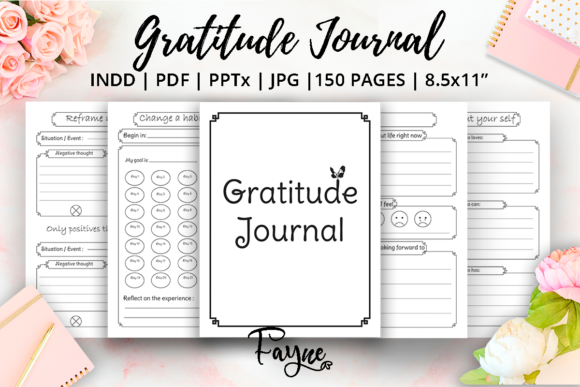
An example of what this looks like in practice: the Positivity Diary & Gratitude Journal below keeps things focused on daily gratitude and broader positivity prompts, without the mood-tracking or coping-strategy pages the broader format would include.
Key Differences Between the Two
- Scope. One is the broad category; the other is one specific, narrower technique within it.
- What you’re asked to write about. The broader format holds space for whatever’s true that day, difficult or not. The narrower one points you specifically toward the positive.
- Structure. One often includes mood trackers or open prompts for working through something. The other tends to be simpler — a short daily or weekly list.
- Time commitment. The gratitude-focused format is usually quick, often just a few minutes. The broader one can take longer, depending on what you’re processing that day.
- Typical use case. Reach for the broader format when you’re working through something specific. Reach for the narrower one when you want a light, positive daily habit.
Which One Is Right for You?
A quick way to tell which one fits what you need right now:
- Working through anxiety, a hard season, or something specific? Start with the broader, mood-tracking format.
- Want a light, quick habit that builds a more positive outlook? The gratitude-focused option is the simpler entry point.
- Not sure where to start? The gratitude-only route is usually the gentler first step, since it asks less of you than an open-ended format.
- Already journaling regularly and want more structure for harder days? One with mood tracking or guided prompts will hold more than a gratitude-only page ever could.
Can You Use Both Together?
Yes, and a lot of people do exactly this without even thinking of it as combining two things. Many broader wellness journals already build a gratitude section into their layout, right alongside mood tracking or reflection prompts. Since gratitude journaling is really just one technique inside that wider category, there’s no real conflict between the two.
A common approach is keeping the broader format for the harder days, and adding a quick gratitude entry as one small, consistent part of that same routine — or a separate short habit alongside it.
One honest note: journaling, gratitude-focused or otherwise, is a helpful daily habit, not a substitute for professional mental health care. If you’re dealing with something significant, it’s worth pairing either journal with support from a doctor or therapist rather than relying on writing alone.
Ready to Start? Here’s Where to Begin
If a broader mental health journal sounds like the better fit, our roundup covers formats built around mood tracking, coping prompts, and daily emotional check-ins.
If a focused gratitude practice is more what you’re after, this roundup covers everything from quick five-minute formats to prompt books and faith-based options.
FAQ
Is a gratitude journal a type of mental health journal?
Yes. It’s one specific technique within that broader category, alongside others like mood tracking or expressive writing about a difficult event.
Can a gratitude journal replace therapy?
No. It’s a helpful daily habit, not professional care. If you’re dealing with something significant, pair journaling with support from a therapist or doctor rather than relying on it alone.
Which one is better for anxiety?
Both can help, but in different ways. The broader format gives you more room to actually process anxious thoughts as they come up, while the gratitude-focused one works more indirectly, by shifting your overall focus toward the positive over time.
Do I need a different journal for each mood?
Not necessarily. Many people keep one broader mental health journal that already has room for a gratitude section, rather than switching between two separate books depending on how they feel.
Final Thoughts
The short version: one is the broad category, and the other is one focused technique inside it. Neither is the “correct” choice — the right starting point is whichever matches what you actually need to work through right now, and there’s nothing stopping you from using both.
You May Also Like
This post contains affiliate links. If you buy through them, we may earn a small commission at no extra cost to you. Learn more.