What Should Be in a Teacher Planner? The Essential Sections to Look For Before You Choose
Scroll through teacher planner listings and it’s easy to end up picking based on which cover looks nicest, rather than asking what should be in a teacher planner in the first place. Some sections are genuinely essential across nearly every teaching situation; others are nice extras that matter more to some teachers than others.
Quick navigation
Table of Contents
The Core Sections Every Teacher Planner Needs
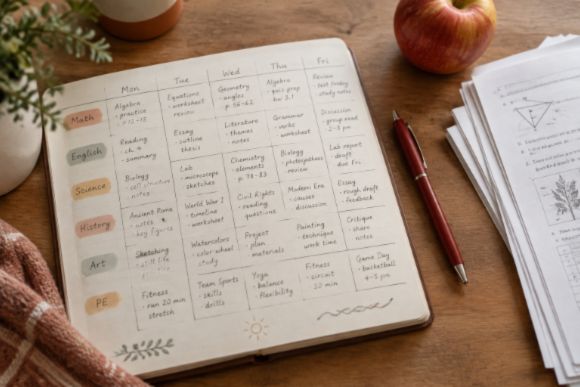
Whenever the question of what should be in a teacher planner comes up, a handful of sections show up in nearly every good one, regardless of grade level or subject. As one planner guide puts it, every teacher planner should include monthly spreads, weekly spreads, and blank pages that can be customized as needed.
- A year-at-a-glance calendar. A single-page overview of the whole academic year, useful for spotting how holidays and breaks fall before you plan anything in detail.
- Monthly spreads. A page per month for tracking deadlines, events, and bigger-picture deadlines at a glance.
- Weekly layouts. Where most day-to-day planning actually happens — this is usually the most-used page in the whole book.
- A dedicated lesson planning section. Enough space for the objective, activities, and assessment for each lesson, not just a single line to jot a topic name.
Student & Classroom Management Pages
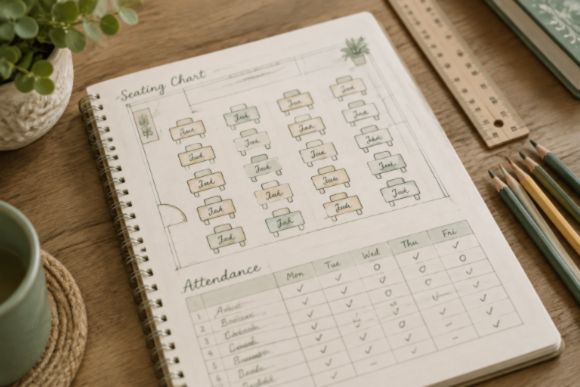
Beyond planning what you’ll teach, a planner needs somewhere to track the people and logistics of the classroom itself:
- Class lists and student information. Names, contact details, and any relevant notes in one place rather than scattered across sticky notes.
- Attendance tracking. A simple grid that covers a full term or year, rather than a single week at a time.
- Grade or assessment tracking. Somewhere to log scores and progress without needing to cross-reference a separate spreadsheet constantly.
- A seating chart page. Genuinely useful for planning group work, adjusting layouts, or sketching out a new arrangement before moving actual desks.
Communication & Professional Pages
A surprising amount of a teacher’s actual workload is communication and reflection, not just lesson delivery, so a good planner makes room for that too:
- A parent communication log. A record of calls, emails, and conversations that’s easy to reference later if a question comes up.
- Meeting notes pages. Somewhere to capture staff meeting takeaways or professional development sessions before the details fade.
- Goal-setting pages. Space for both classroom and personal professional goals, with room to actually revisit and reflect on them later in the year.
Why Blank Pages Matter More Than They Seem To
It’s easy to overlook plain, undesignated pages when comparing planners, but they end up doing real work. No single pre-designed template anticipates every situation a school year throws at you — a substitute’s notes, an unusual field trip form, a one-off tracking need that doesn’t fit any of the built-in pages. Blank pages are where that overflow goes.
A planner with zero flexible space can start to feel restrictive by October, even if every page looked useful back in August.
Nice-to-Haves That Aren’t Essential
Plenty of planners include extras that some teachers love and others never touch:
- A self-care or habit tracker. Genuinely valued by some teachers as a reminder to look after themselves, skipped entirely by others.
- Field trip or substitute-specific pages. Extremely useful if these come up often in your role, unnecessary if they rarely do.
- Decorative elements and stickers. Purely a matter of personal taste — they don’t affect how functional the planner actually is.
None of these are wrong to want, but they’re worth treating as a bonus rather than a dealbreaker if a planner is missing them.
Ready to Start? Here’s Where to Begin
Now that you know what to look for, our roundup covers everything from lean, essentials-only planners to maximalist systems that track every part of the school year.
FAQ
Do I need a daily layout or is weekly enough?
Weekly is enough for most teachers, since it shows the whole flow of lessons at once. A daily layout can help if you teach several distinct subjects or grade levels in a single day and need more room per day than a weekly grid allows.
Should elementary and high school teachers use different planners?
Not necessarily a different planner entirely, but the sections that matter most can shift — elementary teachers often lean more on one class’s full-day schedule, while high school teachers with multiple class periods may want more space per class period rather than per day.
Is a digital teacher planner missing anything a paper one has?
Not in terms of content — a well-designed digital planner can include every section a paper one does. The main difference is just feel: some teachers find handwriting more effective for retention, while others prefer the searchability and portability of a digital version.
What if my planner doesn’t have a section I need?
This is exactly what blank pages are for, and it’s also worth checking whether an editable version exists — several teacher planners are built in Canva or PowerPoint specifically so you can add or adjust sections yourself.
Final Thoughts
So, what should be in a teacher planner? The essentials are fairly consistent — calendars, lesson planning space, student and classroom tracking, and room to communicate and reflect. Everything past that is really about your own teaching style, so don’t feel obligated to pick the planner with the most pages when a simpler one covers what you’ll actually use.
You May Also Like
This post contains affiliate links. If you buy through them, we may earn a small commission at no extra cost to you. Learn more.