Bullet Journal vs Planner: Key Differences and How to Pick the One That Fits Your Life
Both promise to help you get organized, both involve writing things down in a notebook, and both show up constantly in the same Pinterest searches. But a bullet journal and a planner start from opposite ends of the spectrum — one hands you a finished structure, the other hands you a blank page and asks you to build one.
Quick navigation
Table of Contents
Bullet Journal vs Planner: The Quick Answer
A bullet journal is a blank, dotted notebook you build page by page yourself, using a rapid-logging system of simple symbols. A planner comes with the structure already printed in — dated pages, pre-built sections, a fixed layout you fill in rather than design. Choose a bullet journal if you want full control over what each page looks like; choose a planner if you’d rather open a book and start writing without designing anything first.
| Bullet Journal | Planner | |
|---|---|---|
| Structure | Blank — you build every page | Pre-printed and fixed |
| Customization | Unlimited | Limited to what’s already there |
| Setup time | Higher — pages are hand-drawn | Minimal — just start writing |
| Best for | Tailoring the system to your exact life | Getting organized quickly, with no design work |
What Is a Bullet Journal?
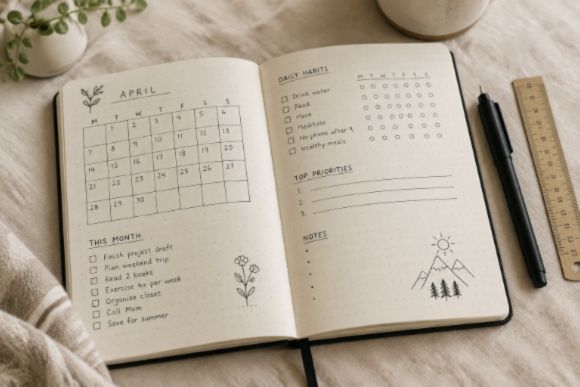
A bullet journal is a blank, usually dotted notebook that becomes whatever you need it to be — a calendar, a to-do list, a habit tracker, a sketchbook — because you’re the one designing every page. Rather than following a fixed layout, you use a rapid-logging system of short entries and simple symbols to capture information quickly.
If you want the full breakdown of how the system actually works and how to start one, we’ve written a separate beginner’s guide covering that in detail.
What Is a Planner?
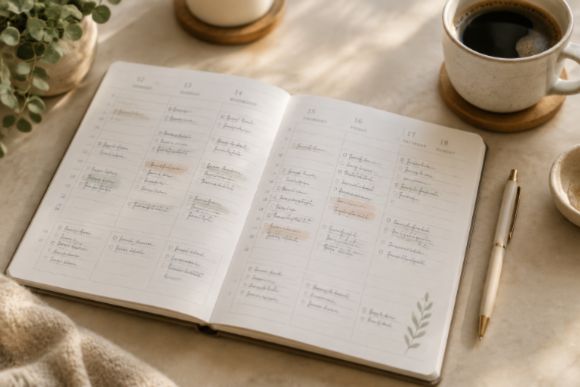
A planner is a pre-printed notebook with the structure already built in — dated calendar pages, weekly or monthly layouts, and often dedicated sections for goals, habits, or notes. You don’t design anything; you just open it to the current day or week and start filling in the boxes that are already there.
Planners range from very simple, calendar-only formats to elaborate systems with dozens of specialized pages, but the defining trait stays the same across all of them: someone else decided the layout before you ever opened the cover.
Key Differences Between the Two
- Who designs the pages. You design every page of one yourself; the other’s pages are already designed before you buy it.
- Flexibility. One can hold literally anything you want to track. The other is limited to whatever sections it was printed with.
- Time investment. Setting up a hand-drawn page takes real time, even for a simple layout. The pre-printed option asks for none of that — you just start writing.
- Supplies. One typically needs just a notebook and a pen, though many people add washi tape or colored pens. The other is usually a complete, ready-to-use product on its own.
- Learning curve. The pre-printed option works the moment you open it. The hand-drawn one usually takes a month or two before the system feels natural rather than effortful.
Which One Is Right for You?
A quick way to tell which one actually fits how you operate:
- Do pre-printed pages regularly feel like the wrong fit? Building your own from scratch lets you get exactly what you need instead.
- Do you want to open a notebook and start writing with zero setup? A ready-made option gets you there immediately.
- Do you enjoy the creative process of designing a page? That’s a real part of the appeal of the hand-drawn approach, not just a side effect.
- Is your schedule fairly consistent and predictable? A fixed layout will likely serve you just as well as a custom one, with far less effort.
Can You Combine Both?
Yes, and plenty of products are built specifically for this middle ground. Dated, “bujo-style” hybrids give you some pre-printed structure — a calendar, an index, section dividers — while still leaving open pages for you to design habit trackers or collections yourself.
It’s also common for people to keep a simple, ready-made notebook for dates and appointments while using a separate one for more personal, hand-drawn tracking — moods, reading, gratitude — rather than trying to force one system to do everything.
Ready to Start? Here’s Where to Begin
If the hand-drawn route sounds like the better fit, our roundup covers layouts and themes for every level, from clean and minimal to fully decorated.
If a ready-made option is more your speed, browse our full collection sorted by format and how you actually use your time.
FAQ
Is a bullet journal a type of planner?
In a broad sense, yes — it can function that way, since it holds your calendar and to-do lists just like a dedicated one would. The difference is that you’re turning a blank notebook into that role yourself, rather than buying a pre-made product built specifically for it.
Which one is cheaper to start?
The hand-drawn route is usually cheaper at the entry level, since a plain notebook and a pen are all you technically need. Pre-printed options vary widely in price depending on how many features and pages they include.
Which one takes more time to maintain?
The hand-drawn approach, by a wide margin, especially if you’re drawing decorative spreads rather than purely functional ones. A pre-printed option takes only as long as it takes to write in the boxes that are already there.
Can I switch from a planner to a bullet journal later?
Yes, plenty of people start with a planner and move to a bullet journal once they’ve noticed specific ways a fixed layout doesn’t fit their life. There’s no rule against switching systems whenever your needs change.
Final Thoughts
The short version: one is a blank notebook you shape yourself, and the other is a finished structure you fill in. Neither is objectively better — the right choice is whichever matches how much control you actually want over your own system.
This post contains affiliate links. If you buy through them, we may earn a small commission at no extra cost to you. Learn more.