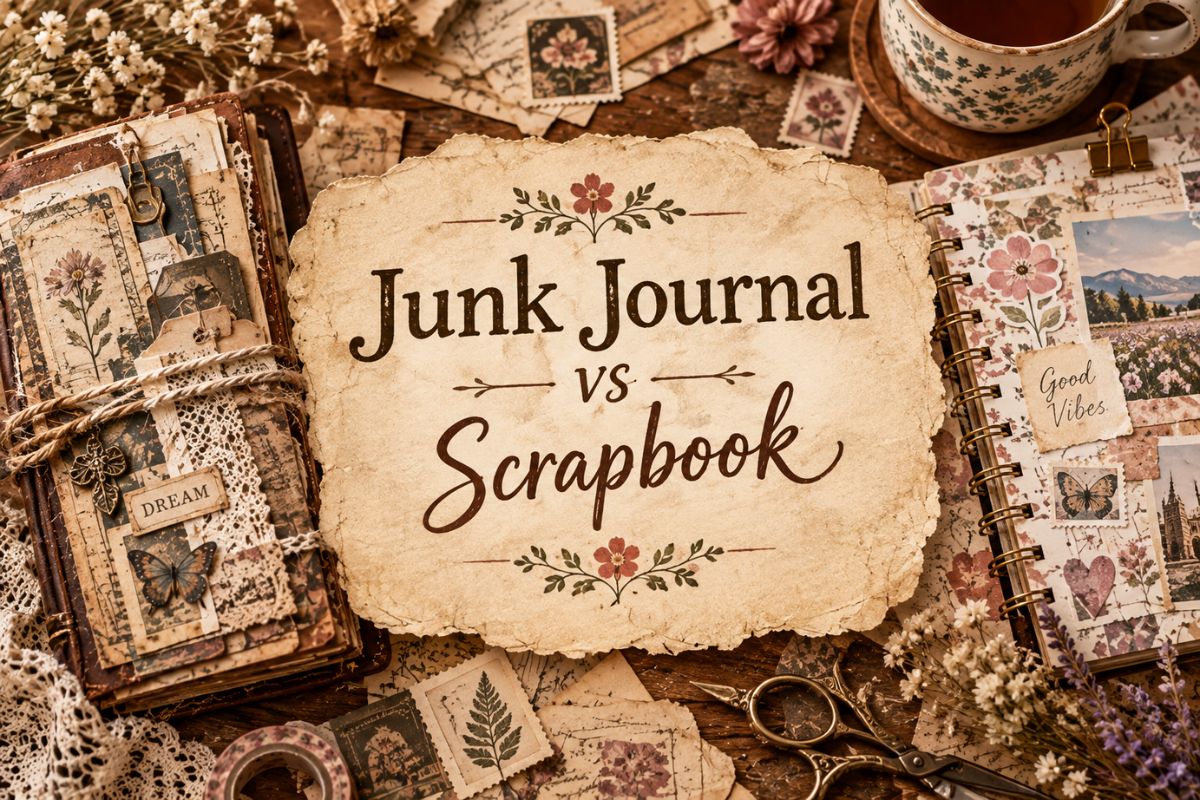
Junk Journal vs Scrapbook: 5 Key Differences to Help You Pick the Right Starting Point and First Supplies
At a glance, junk journaling and scrapbooking can look like the same hobby with two different names — both involve paper, photos, and a lot of glue. But the two crafts start from different places and end up serving different purposes, and knowing which one you’re actually drawn to will save you from buying the wrong supplies.
Quick navigation
Table of Contents
Junk Journal vs Scrapbook: The Quick Answer
A scrapbook is a polished, organized record built around your own photos — meant to preserve specific memories and be handed down or shown off. A junk journal is a handmade, textured book built from found paper and ephemera — meant more for the process of creating than for presenting a tidy record afterward. If you’re starting with photos, you probably want a scrapbook. If you’re starting with a pile of paper scraps you don’t want to throw away, you probably want a junk journal.
| Scrapbook | Junk Journal | |
|---|---|---|
| Starting point | Your photos | Your paper stash |
| Look | Clean, coordinated, readable | Layered, textured, imperfect |
| Materials | New, acid-free, curated | Upcycled, found, mixed |
| The book itself | Usually a store-bought album | Often handmade from scratch |
| Main purpose | Preserve a specific memory or event | Enjoy the process and texture |
What Is a Scrapbook?
This craft is a book built around your own photos and personal memorabilia — tickets, invitations, letters, cards — arranged to tell the story of a specific event, trip, or period of your life. As scrapbooking’s long history shows, the format has always been about memory-keeping rather than art for its own sake. Pages tend to follow large, uniform sizes (commonly 12×12 inches or A4), and the whole point is usually to create something that looks good enough to hand to family or flip through years later without it falling apart.
Because scrapbooks are meant to last, most scrapbookers invest in archival-quality, acid-free paper and adhesives so photos don’t yellow or fade over time. The materials are usually bought specifically for the project — patterned paper, stickers, die cuts, photo corners — rather than repurposed from things lying around the house.
What Is a Junk Journal?
This craft is a handmade book built from repurposed, non-uniform materials — old book pages, receipts, fabric scraps, discarded packaging, vintage ephemera — rather than from supplies bought new for the project. As the format’s own history shows, it grew out of the art-journaling and mixed-media community rather than the memory-keeping tradition scrapbooking comes from. Unlike a memory album, which usually documents the maker’s own life, this kind of book can hold completely unrelated scraps: a stranger’s old postcard, a ticket stub from nowhere in particular, a torn page from a book you’ll never read again.
Many junk journalers build the book itself by hand — folding signatures, stitching the spine, adding pockets and “tuck spots” for smaller pieces — rather than buying a finished album. The look is intentionally imperfect and layered, and the process of tearing, gluing, and arranging tends to matter more than the finished result looking neat.
5 Key Differences Between Junk Journals and Scrapbooks
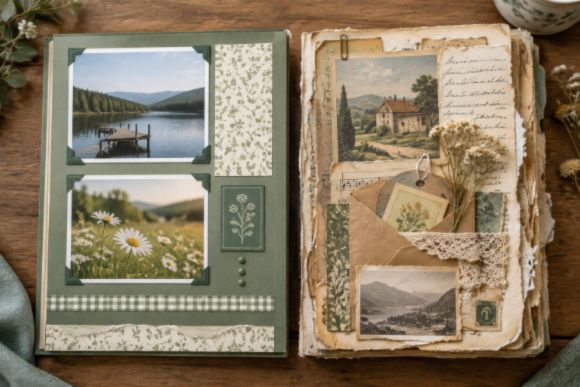
- What you start with. One begins with photos you already have and want to preserve; the other begins with a pile of paper and ephemera you can’t bring yourself to toss.
- The materials. One relies on supplies bought new and chosen to coordinate with each other; the other leans on pieces that are found, upcycled, or mismatched on purpose.
- The structure. One tends toward clean, readable layouts built to be looked at. The other is layered, stuffed with tuck spots and pockets, and built to be handled and explored.
- The book itself. One is usually a pre-made album you buy off the shelf. The other is frequently handmade from scratch, including the binding.
- The purpose. One exists to preserve a specific memory for the long term. The other is as much about the process — the tearing, gluing, and arranging — as whatever ends up in the finished book.
Which One Is Right for You?
Neither craft is “better” — they just answer different needs. A quick way to tell which one fits you right now:
- Want to preserve family photos for future generations? Start with scrapbooking.
- Have a drawer full of ticket stubs, old letters, and paper scraps you can’t bring yourself to toss? Start with a junk journal.
- Prefer clean, coordinated pages you can flip through easily? Scrapbooking will feel more natural.
- Enjoy texture, layers, and a bit of controlled chaos more than a tidy finished look, and want a low-pressure hobby with fewer rules to follow? Go the handmade, paper-scraps route instead.
Can You Combine Both?
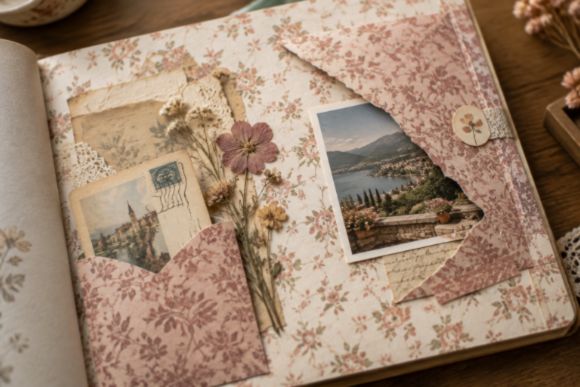
Yes, and a lot of people end up doing exactly that. Photo-album makers often discover this looser, handmade style and start loosening up their own layouts, adding more texture and mixed media instead of sticking to a rigid grid. The reverse happens too — people who start with found paper and ephemera often end up wanting to preserve real photos properly, borrowing habits like archival, acid-free paper for the pages they actually want to last.
There’s no rule that says a journal can’t have a photo in it, or that a scrapbook page can’t include a torn bit of vintage ephemera. The definitions are mostly useful for figuring out where to start and what supplies to buy first — after that, most people happily blend the two.
Ready to Start? Here’s Where to Begin
If a junk journal sounds like your kind of project, start with the ephemera, paper, and embellishments that make the format work — our beginner-friendly roundup walks through exactly what to look for and where to find it.
If scrapbooking is more your speed, these roundups cover the supplies you’ll actually need — from full bundles to individual paper and digital kits.
FAQ
Do I need to choose just one?
No. Plenty of crafters do both, either as two separate projects or blended into one hybrid book. Starting with whichever one matches what’s already sitting on your desk is usually the easiest way in.
Which one is cheaper to start?
Junk journaling is usually cheaper to begin, since the whole idea is to use materials you already have or can find for free — old books, packaging, scrap paper. Scrapbooking tends to cost more upfront because it relies on new, coordinated supplies and a proper album.
Can a junk journal include photos?
Absolutely. There’s no rule against it — plenty of junk journals include real photos alongside found ephemera. It’s just not the main focus the way it is in a scrapbook.
Is one of these better for beginners?
Junk journaling tends to be more forgiving for beginners since there’s no “wrong” way to do it and mistakes just add to the texture. Scrapbooking has a few more conventions around layout and archival materials, which can feel a little more structured to learn at first.
Final Thoughts
The short version: one keeps your memories, the other keeps your paper. The definitions matter just enough to help you pick a starting point and buy the right first supplies — after that, the line gets happily blurry, and that’s exactly how it should be.
This post contains affiliate links. If you buy through them, we may earn a small commission at no extra cost to you. Learn more.