What to Include in a Wedding Planner: 9 Sections to Keep or Skip So Every Page Earns Its Place
Most people picking their first wedding planner focus entirely on how it looks… What actually determines whether you’ll use the thing for the next twelve months is knowing what to include in a wedding planner for your specific wedding, not a dozen pages you’ll never open.
Why Section Choice Matters More Than Design
A wedding planner with fifty pages sounds impressive until you realize fifteen of them are for things you don’t need — a seating chart for a fifteen-person elopement, a honeymoon planner when you’re not taking one right after, a bridal shower tracker when your maid of honor is handling that separately. Every irrelevant section is just friction between you and the pages you actually need to open regularly.
On the other hand, a planner that’s too minimal can leave you scrambling to track things by memory or scattered sticky notes once the wedding gets more complex than expected. The goal isn’t the biggest planner or the smallest one — it’s the one where every section actually earns its place for your specific wedding.
What to Include in a Wedding Planner: What Each Section Actually Controls
Here’s what the common sections in a wedding planner are actually for, and how to tell whether you personally need them.
Vision Board & Style Pages
This controls the overall look and feel — color palette, theme, general aesthetic direction. It’s genuinely useful early on, before you’ve booked a venue or vendors, since it gives you a reference point to check every decision against later.
Skip it if: you already have a crystal-clear vision in your head, or you’re using a separate dedicated vision board tool instead. Keep it if: you tend to second-guess aesthetic choices once you start seeing options.
Budget Planner
This is the section almost nobody should skip. It controls what you can actually afford across every other category — venue, catering, dress, flowers — and without it, decisions tend to get made in isolation, one at a time, until the total quietly exceeds what you meant to spend.
Skip it if: you’re already using a separate, dedicated budget tool you trust more. Keep it if: you want your spending and your planning to live in one place instead of two.
Guest List & RSVP Tracker
This controls exactly who’s coming, which cascades into catering counts, seating, invitations, and favors. The bigger your guest list, the more this section matters — a 200-person wedding without a real RSVP tracker is asking for trouble, while a 20-person one might manage fine with a simple list.
Skip it if: your guest list is small enough to hold in your head or a basic spreadsheet. Keep it if: you’re inviting more than about 50 people, where tracking responses by memory stops being realistic.
Vendor & Contract Management
This controls contact details, deposit amounts, contract terms, and payment schedules across every vendor you hire. It’s the section that saves you from realizing three weeks before the wedding that you never confirmed the final headcount with the caterer.
Skip it if: you’re only hiring one or two vendors total. Keep it if: you’re coordinating five or more separate vendors, where details genuinely start blurring together.
Timeline & Checklist
This controls when things need to happen — invitations mailed by a certain date, dress ordered with enough time for alterations, final vendor payments due before the big day. It’s arguably the second-most essential section after budget, since most wedding stress comes from discovering a deadline too late rather than the task itself being hard.
Skip it if: you’re planning a very short engagement with few moving pieces. Keep it if: your engagement runs longer than about six months, where it’s easy to lose track of what should be done by when.
Seating Chart
This controls table assignments and the social dynamics of the reception — who sits with whom, and avoiding the awkward pairing of guests who shouldn’t be at the same table. It only becomes genuinely necessary once you’re dealing with assigned seating at all.
Skip it if: your reception is standing, casual, or has open seating. Keep it if: you’re doing a formal sit-down reception with assigned tables.
Ceremony & Reception Details
This controls the actual run of show — processional order, vows, first dance, toasts, cake cutting. It matters most for anyone with specific traditions, readings, or moments they want to make sure don’t get forgotten in the moment.
Skip it if: you’re having a very simple ceremony with a officiant handling most of the structure. Keep it if: you’re planning specific rituals, readings, or a longer reception program with several distinct moments.
Honeymoon Planner
This controls travel logistics for the trip after the wedding — bookings, packing, itinerary. It’s genuinely one of the most skippable sections if the honeymoon isn’t happening right away or is being planned as its own separate project.
Skip it if: you’re not honeymooning immediately, or you’d rather plan that trip separately once the wedding itself is behind you. Keep it if: you’re traveling right after and want everything in one place before you’re too exhausted to plan anything new.
Bridal Shower & Related Events
This controls planning for events around the wedding itself — the shower, an engagement party, a rehearsal dinner. Useful only if you’re the one actually organizing these, rather than a maid of honor or family member handling them independently.
Skip it if: someone else is planning your shower or related events. Keep it if: you’re organizing any of these yourself and want them tracked alongside the main wedding.
So, Minimal or Comprehensive?
Once you know what to include in a wedding planner, a few honest questions tend to settle whether you need the full version or something leaner.
- How many people are involved? A 20-guest backyard wedding and a 200-guest formal event need genuinely different levels of tracking.
- Are you planning this alone, or with a coordinator? A hired planner may already be tracking vendors and timelines, which frees you to use a lighter personal planner just for your own notes.
- How long is your engagement? A longer runway benefits more from a detailed timeline section than a short, fast-moving engagement does.
- Do unused pages bother you, or do you just skip past them? Some people don’t mind a comprehensive planner with a few unused sections. Others find empty pages distracting and prefer something leaner.
If most of your answers point toward a bigger, more complex wedding — more guests, a longer engagement, no outside coordinator — a comprehensive planner earns its size. If your wedding is smaller or simpler, a leaner planner focused on just the sections that matter to you will likely get used more consistently than an overwhelming one.
Find the Right One
Now that you know which sections actually matter for your wedding, it’s easier to tell which planner format fits — whether that’s a lean printable binder or a full 100-plus-page system covering everything from engagement to honeymoon.
A Good Starting Point
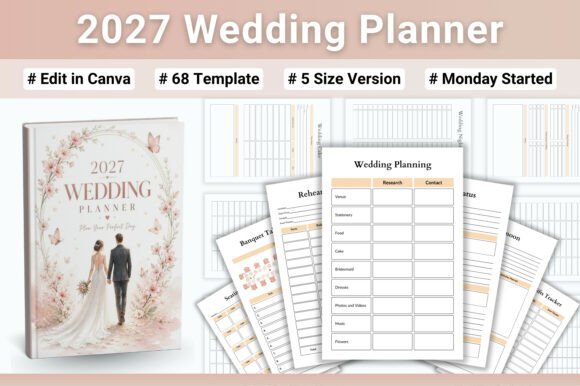
This one sits firmly on the comprehensive end of the spectrum — 68 pages covering nearly every section discussed above at once, including a few that most planners skip entirely, like a wellness calendar and a dedicated engagement party section. Available in five different page sizes, so it fits whatever binder or printing setup you already use.
A strong pick if most of your answers above pointed toward “keep it” rather than “skip it” — a bigger wedding, a longer engagement, and no outside coordinator handling the details for you. Not the right choice if you only needed two or three of the sections covered here.
Final Thoughts
The best wedding planner isn’t the prettiest one or the most complete one — it’s the one where every section reflects something you actually need to track. Figure out which of these categories genuinely apply to your wedding before you shop for the design, and the rest of the decision gets a lot simpler.
This post contains affiliate links. If you buy through them, we may earn a small commission at no extra cost to you. Learn more.