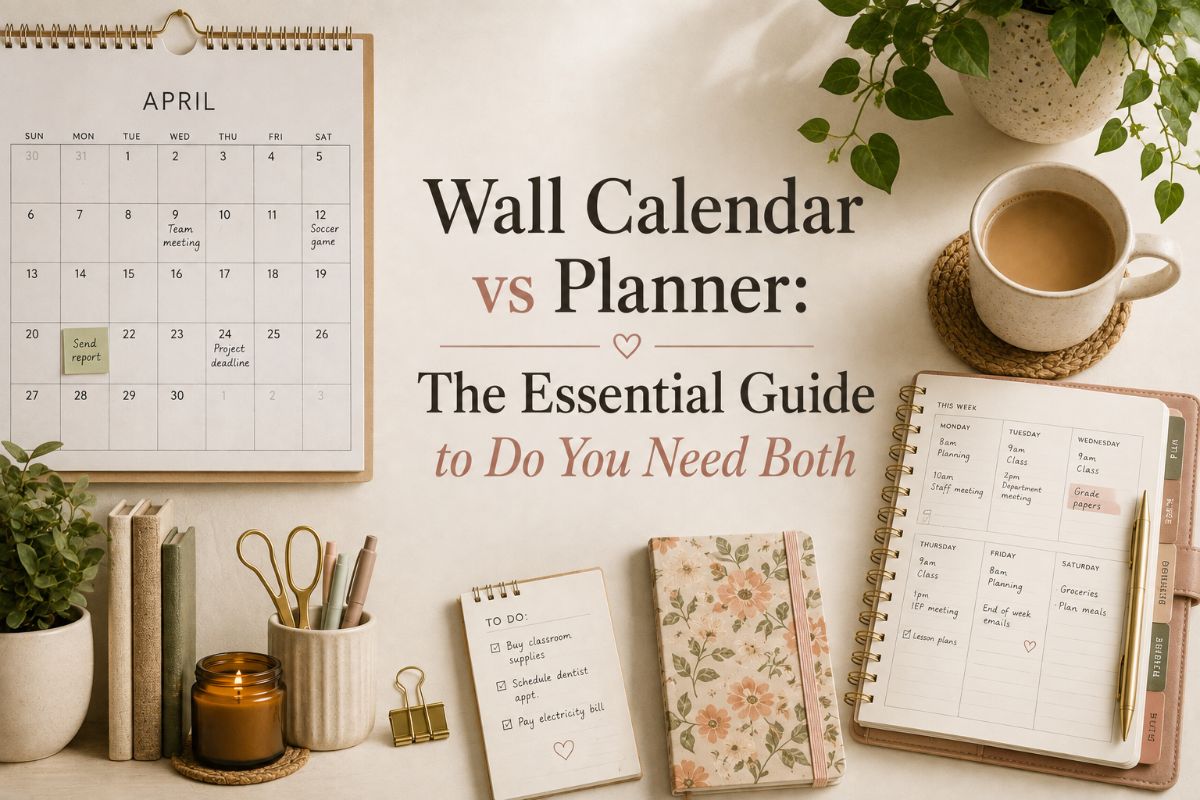
Wall Calendar vs Planner: Do You Need Both? How to Choose and Use Them Together
You’ve got a planner, or you’re thinking about getting one — so does a wall calendar actually add anything, or is it just decoration? The honest answer is that they’re built for genuinely different jobs, and most organizational guides land in the same place once you dig into it.
Quick navigation
Table of Contents
Wall Calendar vs Planner: The Quick Answer
A wall calendar gives you a big-picture, at-a-glance view of the month — the kind of visible reminder that’s hard to ignore because it’s hanging right in front of you. A planner handles the details: daily tasks, to-do lists, and the step-by-step work that happens between the dates on the calendar. They’re not competing for the same job, which is why most organizational guides land on the same answer: use a wall calendar for visibility and shared dates, and a planner for the actual planning.
| Wall Calendar | Planner | |
|---|---|---|
| Best for | Big-picture visibility, shared dates | Daily tasks, detailed planning |
| Where it lives | On the wall, always visible | In a bag or on a desk, opened to use |
| Who sees it | Often the whole household | Usually just you |
| Typical content | Birthdays, holidays, major deadlines | To-do lists, appointments, goals |
What Is a Wall Calendar Actually For?
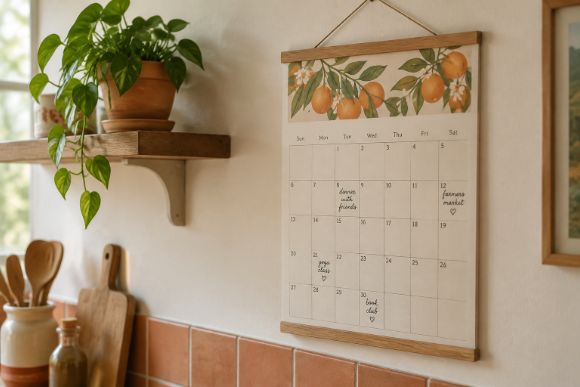
A wall calendar’s whole job is visibility. Unlike a planner tucked away in a bag or a reminder buried in an app, a wall calendar demands attention simply by being hung somewhere you’ll walk past it daily. That makes it especially useful for dates that affect more than just you — household events, birthdays, holidays, and deadlines everyone in the house needs to know about without having to ask.
It also gives you a genuine big-picture view in a way the day-to-day option usually doesn’t — a full month laid out at once, rather than one week or day at a time.
What Is a Planner Actually For?
This option — sometimes called a personal organizer — handles everything that happens between the dates on a calendar: the daily tasks, to-do lists, and goal tracking that a quick glance at a monthly grid was never designed to hold. Where a calendar tells you something is happening, this is where you actually work out what to do about it.
It’s also inherently more private and detailed than something hanging on the wall — nobody else needs to see your daily task list, and there’s room to hold far more detail per day than a single square on a monthly grid ever could.
Key Differences Between the Two
- Visibility. One is always in view by design; the other only shows its contents when you open it.
- Scope. One shows a full month at a glance; the other typically focuses on a day or week with much more detail.
- Audience. One is often shared with a whole household; the other is usually personal.
- Depth. One holds detailed tasks and goals; the other holds just the headline — a date and a short label.
- Portability. One travels with you; the other stays put in one fixed location.
Which One Do You Actually Need?
A quick way to tell which one solves your actual problem:
- Do you forget about events because reminders stay hidden in an app or a closed notebook? A visible, hanging option solves exactly that.
- Do you need to coordinate dates with other people in your household? A shared, visible option is built for that; a personal one isn’t.
- Is your real struggle daily tasks and follow-through, not just remembering dates? That’s the detailed tool’s job, not the visible reminder’s.
- Do you need something portable you can carry with you? One travels; the other doesn’t.
Do You Need Both?

For a lot of people, honestly, yes — and this is where most organizational guides on the topic actually agree. The idea isn’t choosing one over the other, but creating a personalized system that uses both in complementary ways. A common approach: let the wall-mounted option hold big-picture, shared events — birthdays, holidays, appointments everyone needs to see — and let the detailed, personal one handle the daily tasks, goals, and to-do lists that don’t need to be visible to the whole house.
The two systems work best when you’re consistent about what goes where, rather than duplicating everything in both places. A quick weekly check-in to make sure nothing important has fallen through the cracks is usually enough to keep them in sync.
Ready to Start? Here’s Where to Begin
If a wall calendar sounds like the piece you’re missing, our roundup covers designs sorted by style — bold wall art, animal desk designs, and photo calendars.
If it’s a planner you actually need, browse our full collection sorted by how you plan your time.
FAQ
Can a wall calendar replace a planner for a student?
Not really. It can show a broad sense of how busy a month looks, but it doesn’t have room for daily assignments, study schedules, or task breakdowns the way a more detailed tool does. Many students find they genuinely need both, even if one of them ends up digital rather than hung on a wall.
What should go on the wall calendar vs in the planner?
A reasonable split: the visible, shared option holds dates that affect other people or need to be seen at a glance — birthdays, holidays, shared appointments. The personal, detailed one holds your own daily tasks, to-do lists, and goals that don’t need to be visible to anyone else.
Is a digital calendar enough instead of a physical wall calendar?
For some people, yes — a digital version syncs across devices and sends reminders a paper one can’t. But a physical, hanging option offers something digital versions don’t: an always-visible reminder you can’t accidentally dismiss or forget to check, which is exactly why plenty of people keep both.
What if my planner and wall calendar show different things?
That’s a sign the two systems need a quick sync, not that either one is unnecessary. A short weekly check-in to transfer anything important between them is usually enough to keep things aligned.
Final Thoughts
The short version: one is for visibility and shared dates, the other is for the detailed work of actually getting things done. Most organizational advice lands in the same place — not choosing one over the other, but letting each do the job it’s actually built for.
You May Also Like
This post contains affiliate links. If you buy through them, we may earn a small commission at no extra cost to you. Learn more.