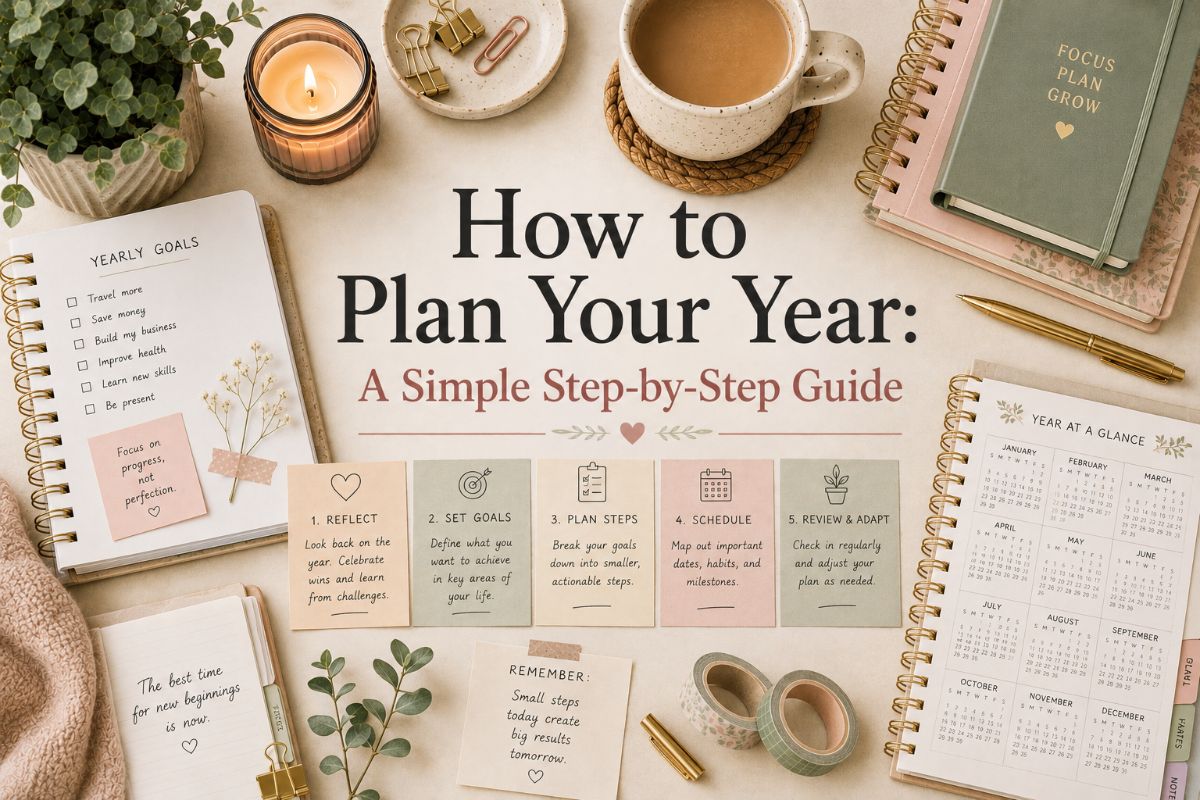
How to Plan Your Year: 6 Simple Steps to Turn a Vague List of Wishes Into a Plan You Will Actually Follow
Knowing how to plan your year turns a vague list of wishes into a plan you can follow. Instead of reacting to each week as it comes, you decide in advance what matters, put key dates on the page, and break big goals into steps that fit into four quarters.
This guide walks you through a simple six-step method you can finish in one evening, on paper, in a printable, or on a tablet. You’ll also find tips for keeping the plan going after the first month, and two planner layouts that make the steps easier.
Quick navigation
Table of Contents
What You Need to Get Started
Learning how to plan your year doesn’t require special tools. A blank sheet of paper works, and so does a printable or digital planner page. Set aside one quiet evening and have these ready:
- A yearly planner page, a printable, or a blank sheet of paper
- Your phone or wall calendar, so you can copy in fixed dates
- A pen or a stylus, plus a highlighter or two colors
- One to two hours without interruptions
How to Plan Your Year in 6 Steps
Work through the steps in order, because each one builds on the one before. None of them should take more than about twenty minutes.
Step 1: Look Back at the Past Year
Before you plan ahead, spend ten minutes on the year behind you. Write down what went well, what drained your time, and what you kept putting off. Patterns show up quickly: maybe spring is always packed, or a goal kept slipping because it was too big. These notes tell you what to repeat and what to change.
A simple way to sort your notes is three short lists:
- Keep: routines and habits that worked
- Drop: commitments that cost more than they gave back
- Try: one or two new things you want to test this year
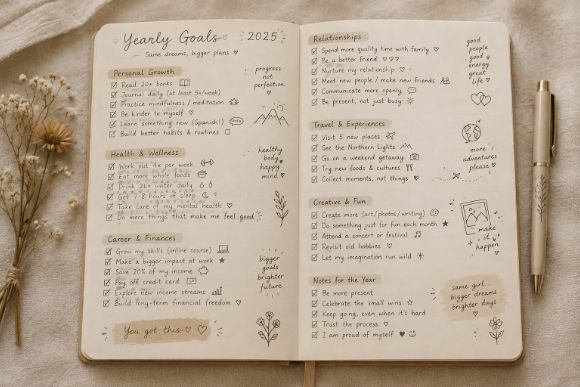
Step 2: Choose Three to Five Main Goals
A short list is easier to follow than a long one, so pick three to five goals for the year. Write each one as a clear result with a finish line. “Save $2,000 for a trip” gives you something to aim at, while “save more” does not.
Test every goal with three quick questions: Does it matter to me? Can I tell when it’s done? Is there room for it in my schedule? If the answer to any of them is no, rewrite the goal or move it to next year.
Step 3: Split Each Goal into Quarters
Big goals feel lighter when you cut them into four parts. For each goal, decide what should be finished by the end of March, June, September, and December. The first quarter is usually for setup and research, the middle two for the main work, and the last for finishing and review.
Here is how it looks for a goal like “run a 10K”: in the first quarter you build a routine of three short runs a week, in the second you work up to five kilometers, in the third you sign up for a race and train for the full distance, and in the fourth you run it and set the next target.
Step 4: Mark Your Fixed Dates
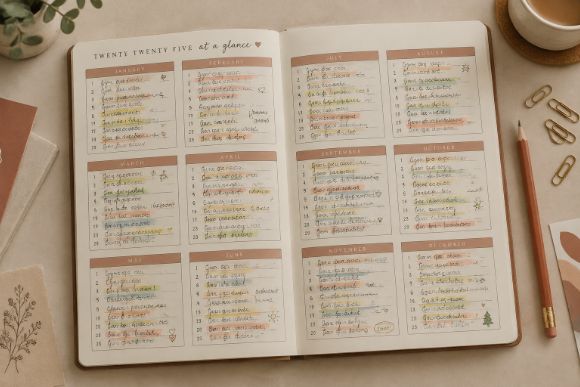
Now add everything that already has a date: birthdays, holidays, school breaks, trips, appointments, and deadlines. This step comes after your goals on purpose. Once the fixed dates are on the page, you can see which months are packed and which have room, and that tells you where goal work can realistically fit.
Using one color for work, one for family, and one for travel makes the busy stretches easy to spot at a glance.
Step 5: Place Projects and Milestones Month by Month
Take each quarterly step from Step 3 and drop it into a specific month, working around your fixed dates. Put the hardest tasks in the months with the fewest commitments, and keep busy months light. Two or three main focus items per month is plenty.
Step 6: Set Review Dates
A plan only works if you look at it. Put a review on the calendar at the end of each quarter, and add a ten-minute check once a month. At each review, ask yourself three questions:
- What got done?
- What got in the way?
- What needs to move to a different month?
Adjusting the plan is part of the process. Moving a milestone is better than dropping the whole goal.
That is the whole method for how to plan your year: look back, choose goals, split them into quarters, add your dates, place your projects, and review.
How to Stick to Your Yearly Plan
Knowing how to plan your year is only half the job, and following the plan is the other half. Most yearly plans fade in February because nothing connects them to daily life. These habits keep the plan in front of you:
- Keep it visible. Put the planner page on your desk or wall, or pin it as the first page in your tablet app.
- Pick a weekly check-in. Ten minutes every Sunday is enough to see what’s coming and pick your next steps.
- Go down a level. Turn each month into a weekly layout with a monthly planner and a weekly planner, so the big goals become small tasks.
- Fill the pages with ideas. Not sure what else to put in your planner? See our yearly planner ideas for 12 pages to add.
- Leave slack. One lighter week per quarter gives you room to catch up.
- Don’t start over when you fall behind. Look at the next milestone and continue from there.
Which Yearly Planner Format Fits Your Plan?
You can follow all six steps on a blank sheet of paper. A planner with ready-made pages simply removes the setup, so your time goes into planning instead of drawing lines and boxes. Here are two layouts that match the steps above:
FOUR-QUARTER LAYOUT
Yearly Planner Quarterly Template 1
This printable yearly plan is divided into four quarters. Each quarter has bullet list sections plus empty boxes for each month, so you can plan goals, tasks, and priorities in a simple, flexible way.
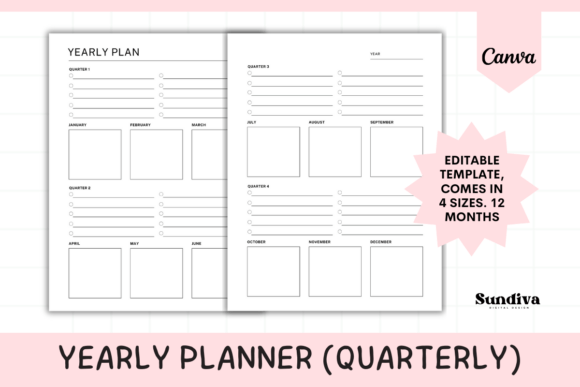
Sizes: US Letter, A4, A5, and Half Letter | Files: Canva template and print-ready PDF
Best for: setting yearly goals, breaking plans into quarters, and staying organized month by month. It fits Steps 3 and 5 of this guide, when you split goals into quarters and months.
- Bullet list sections in each quarter
- Empty boxes for each month
- Works in binders, planners, journals, or digital planning
- Opens with a free Canva account, on a computer or in the phone app
Edit it in Canva or use the print-ready PDF files as they are. Choose this one if you think in quarters; skip it if you want a day-by-day layout.
PASTEL TWO-YEAR PLANNER
2027-2028 Minimal Planner Canva Template
This pastel, minimal planner covers two years in one soft, aesthetic system. The planning pages run from yearly and quarterly down to monthly, weekly, and daily layouts, and each level has room for goals, tasks, reflections, and gratitude.
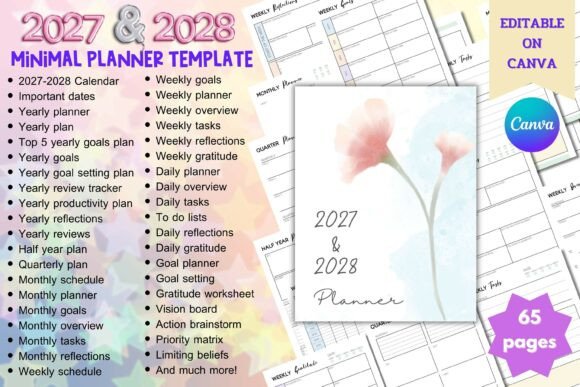
Years: 2027 and 2028 | Pages: 65 | Size: US Letter (resizable) | Week start: Sunday or Monday | Editable in: Canva (free version)
Best for: students, entrepreneurs, creators, and anyone who loves aesthetic digital planning. It covers every step of this guide in one system.
- Yearly pages for top goals, goal setting, reviews, and reflections
- Half-year and quarterly plans, plus monthly, weekly, and daily pages
- Vision board, priority matrix, habit tracker, and a 30-day challenge
- Budget pages for income, expenses, bills, and yearly savings
- Ready to print or use digitally
You can change fonts, colors, text, and elements with a free Canva account, and add or delete pages as you need them. Choose this one if you want a soft, all-in-one planning system for two years; skip it if you only need a single-page overview.
Want to see more options, such as one-page year-at-a-glance calendars and tablet planners? Browse our full collection of yearly planner templates, grouped by style and purpose.
FAQ
When should I start planning the new year?
Late November or December works well, because the past year is still fresh and holiday dates are known. But any time is a good time to start. A plan made in March is better than no plan at all.
What should I include in a yearly plan?
A basic yearly plan has your fixed dates, three to five main goals, quarterly milestones, and review dates. If they matter to you, you can add a habit tracker, a budget page, or a vision board. Start with the basics and add extras only when you need them.
How do I plan my year if I get overwhelmed easily?
If you’re unsure how to plan your year without the stress, make everything smaller. Choose only three goals, plan at the quarter level first, and fill in months one quarter at a time. A single one-page layout is easier to face than a thick planner, and a short monthly check is easier to keep than a long review.
Is it too late to plan my year if I’m already a few months in?
No, and it’s never too late to learn how to plan your year. Start from today and treat the months you have left as your year. List what you want to finish by December, split it across the remaining quarters, and set your first review date.
Can I plan my year on a tablet instead of paper?
Yes. PDF planners can be opened in apps like GoodNotes or Notability, and Canva templates can be edited on a computer or in the Canva app. Many people print a one-page yearly overview for the wall and keep the detailed pages on a tablet.
Final Thoughts
Knowing how to plan your year doesn’t take a perfect system. It takes a few honest hours, a short list of goals, and a plan you will actually look at. Review the past year, pick your goals, split them into quarters, mark your dates, place your projects, and schedule your reviews. Then adjust as the year goes on, because a plan that bends is a plan that lasts.
You May Also Like
This post contains affiliate links. If you buy through them, we may earn a small commission at no extra cost to you. Learn more.